Museos y Exposiciones

Altavoz

Caesaraugusta River Port Museum

The Forum and Port of Caesaraugusta

The Forum of Caesaraugusta was formed by a large central square with porticoes, surrounded by public buildings anch presided by a large temple, whose remains are underneath La Seo (cathedral).

In the subsoil of today´s city two sectors of its constructions, which have been preserved, can be visited: Caesaraugusta´s Forum Museum (whose entrance is in La Seo Square), with a large swer, part of the porticoes, shops and public buildings on the south eastern boundary; and Caesaraugusta´s River Port Museum (entrance in San Bruno´s Square), which marks the north eastern boundary of this complex with the remains of the building that led from the banks of the Ebro to the Forum.

The Ebro river was navigable in ancient times from the city of Vareia (present Logroño). Its banks boasted wharves and large ports; Caesaragusta´s port probably occupied most of the rignt bank of the city along a straight section, well-protected and with still waters after a sharp meander.

The Monumental Building

Among the structures that form the north eastern limits of the Forum there are the remains of a large building which was probably used as a warehouse anch which linked the banks of the Ebro with the Forum.

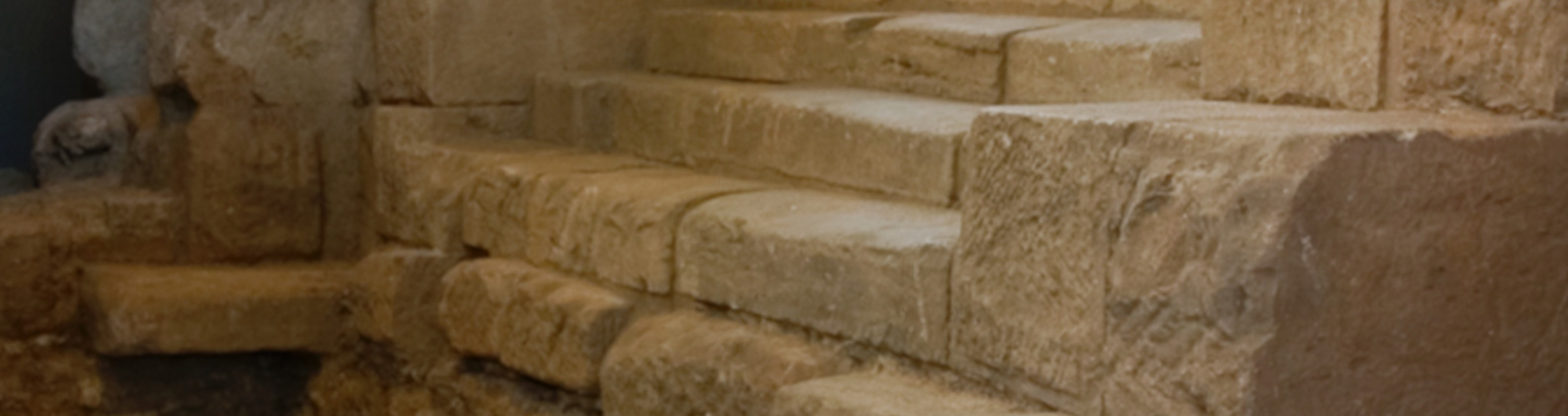
Facing the river there was a beautiful facade with archways which led to the vestibule of the monumental building, overcoming, by means of a stairway, the difference in height between the port and the Forum´s large square.

In some of the ashlarwork of this building, constructed around the turns of the Era, there are still quarry marks made by the builders: soldiers belonging to the 6th Victrix legion, the 4th Macedonia legion and the 10th Gemina legion, founders of the city of Caesaragusta.

The River Trade

During the Roman perido a flourishing trade sprang up along the banks of the Ebro river.

The main ports were those of Vareia, now Logroño, Destrosa, present Tortosa and Caesargusta, the most important strategic site form the redistribution of merchandise in the center of the Valley.

Imported goods were brought upstream from Destrosa, a combined sea and river port, which at the time did not have the Ebro delta. Pottery, marble, amphorae of wine and salted food, jewels, glass items, etc., all made the journery up river. The Valley´s products: wool, leather, iron, linen, salt, wheat and wood were transported down river.

From the coins minted by Destrosa (Municipium Hibera Iulia Ilercavonia) we have an idea of the boats that sailed the Ebro in Roman times. These coins bear the image of the helm and the square sails that sped the boats along, although tow-paths were also used to pull them upstream following the method used on other southern European rivers.