



Renaissance Walk

Throughout the 16th century the appearance of the city was completely renewed. Many palatial houses reflect the financial development of the Kingdom of Aragon and its capital. Your visit is the most outstanding aspect of our Renaissance Walk.

This visit is only available for groups with prior reservation.

Prices

  • Regular Price: 5,60 euros per person.
  • Other prices: 2,80 euros per person (more than 65 years old, unemployed and educational groups).

* Groups of at least 15 people.

* For discounted rates, an updated document must be shown that proves it.

* Entrance fee to the Patio de la Infanta not included (1,50 euros per person).

Booking

More information

ODS

Esta actividad está alineada con los siguientes ODS:

Galería de imágenes: 3 de 18
Galería de imágenes: 8 de 18
Galería de imágenes: 11 de 18
Galería de imágenes: 17 de 18

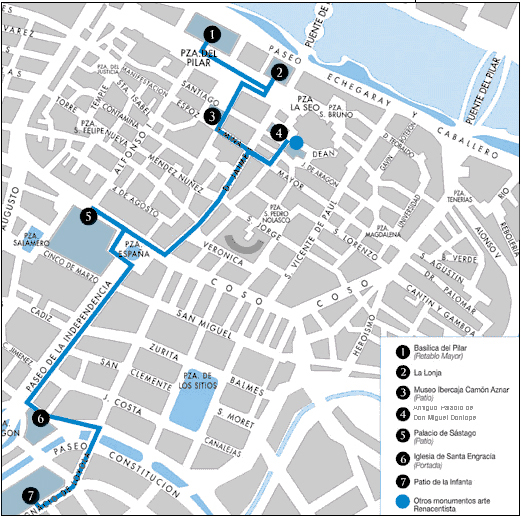
Route

These are the monuments that are visited on this tour:


Basílica del Pilar - Retablo Mayor

The Pilar Basilica is one of the most important Marian sanctuaries in the catholic world and is visited every year by thousands of pilgrims. It is also a leading artistic centre with a collection of valuable works from different periods, in particular the frescos by Goya.

See more >

La Lonja. (The interior is only visited if there is an exhibition)

The building was built by the council and, according to the project leader, Juan de Sariñena, it was intended to be a marketplace for traders. It’s the first completely Renaissance building in the city and the most important 16 th -century civil construction in Aragón.

See more >


Palacio real maestranza de caballería. (The interior is only visited on the Saturday walk)

Headquarters of the Royal Armoured Calvary since 1912. It was commissioned by the jurist Miguel Donlope, and was not finished until the last quarter of the 16th century.

See more >

Patio del Museo Goya - Colección Ibercaja. Camón Aznar Museum

The Goya Museum-Ibercaja Collection was opened in 1979 in the former house of Jerónimo Cósida – one of the most beautiful examples of Renaissance civil architecture in Zaragoza.

See more >


Gatehouse of the Church - Basílica de Santa Engracia

The Hieronymite monastery of Santa Engracia was built in the 15th-16th centuries on the site of the ancient Christian-Roman necropolis, where the two marble sarcophagi now kept in its crypt were found: the Receptio Animae and the Petrine Trilogy, dating from the 4th century.

See more >

Patio de la Infanta (The interior can only be visited if there is an exhibition)

This courtyard was built in the middle of the 16 th century and was part of a palace on Calle de San Juan owned by the banker and merchant, Gabriel Zaporta. It has a typical Aragonese Renaissance design and is especially notable for its novel decoration.

See more >


Patio of Sastago Palace (The interior can only be visited if there is an exhibition)

In the 16th century, the Coso was considered the most spacious and beautiful street in the city. As the setting for processions, Royal corteges and home to the Zaragoza nobility, it was chosen by the Count of Sagasto and Viceroy of Aragon, Don Artal de Aragon to build his sumptuous residence.

See more >

Other Renaissance art monuments in the city

Monuments not included in the visit

The Huarte Palace

Its present day name corresponds to that of its owner at the beginning of the 20th century, the Marques of Huarte. It was constructed sometime during the first twenty years of the 16th century, as the final gothic forms gave way to the initial renaissance style.

See more >
 
ZGZ. We can help you?

#ZARAGOZATURISMO

Aviso

Utilizamos cookies propias y de terceros para mejorar nuestros servicios.

Política de cookies

Gestionar preferencias de cookies


De análisis Ver detalle

Tipo de cookieDescripciónFinalidadesPlazo de conservación
Google Analytics_gaEsta cookie genera un ID de usuario único y registra la fecha, la primera y la última vez que el usuario vistió la web. Se utiliza para hacer recuento de cuantas veces visita el sitio un usuario único.2 años
Google Analytics_gidEsta cookie registra la hora de llegada a la página y caduca a las 24 horas. Sirve para calcular el tiempo que un usuario permanece en una página.24 horas
Google Analytics_gatSe usa para limitar el porcentaje de solicitudes1 minuto
  • Cookie: ac_enable_tracking
  • Titular: ActiveCampaign
  • Fecha de caducidad: 1 mes
  • Funcionalidad: Esta cookie está asociada con Active Campaign y está configurada para confirmar que el seguimiento se ha habilitado para el sitio web. El seguimiento se utiliza para crear informes de nuestro tráfico web y mejorar la experiencia del usuario del sitio web.