
RENAISSANCE Project in Zaragoza
Actions
Examples and actions of bioclimatic building and energy efficiency in Zaragoza
- Previous actions: Parque Goya
- New actions: Valdespartera
- Rehabilitation: Picarral
- Rehabilitation: Cándido Domingo Public School
Previous actions: Parque Goya
The first experiences in bioclimatic architecture in Zaragoza started in 1984 with the construction of a house designed using bioclimatic criteria. In 1990, Proyecto HOMBRE is launched, a residence for 80 drug addicts with the support of the EU program THERMIE. Its success allowed to transfer this project into an urban one, Parque Goya. The result was 3,500 households from which 300 were monitored in a new European project. Later on, several development projects have followed the guidelines of Parque Goya, a pioneer project in Spain, that has culminated in the project Valdespartera Ecocity -almost 10,000 households for an urbanisation designed from the conclusions drew by the monitorisation of Parque Goya.
It is important to point out that, nearly all the 15,000 households built with bioclimatic criteria, have been subsidised houses.
Two districts will benefit from the establishment of new systems for an efficient management of energies, one already existing and a another new: a wide restoration of buildings and urban regeneration at El Picarral (400 households), and the new Valdespartera district (616 households). In addition, there will be an illustrative action on an educational centre located at El Picarral.
New actions: Valdespartera
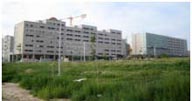
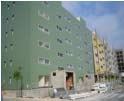
Valdespartera, with the construction of 9,687 households (97% subsidised), incorporates a set of planning innovations in the urbanisation and management project, making possible to reach the fundamental goal of sustainability in its environmental, economic, social and cultural view.
The development project includes advanced service networks in order to secure a rational consumption of resources such as a double separate system -from one hand a supply and irrigation water system, and from the other a rain and faecal one-, a system of pneumatic garbage collection, and also a remote control network allowing an autonomous monitoring of the services networks and an immediate action in case of leak, allowing saving-consumption.
The Remote Control Network is centralised through an Interpretation Centre from which it will be possible to carry out a centralisation of climate, energy, and environment data, and also of networks consumption data.
Valdespartera has tried to set out a planning that, being oriented to achieving sustainable development, can boost mixed uses, facing the segregation of functions and special uses that provokes a waste of energy and time.
Valdespartera has been recognised the last two years as a worldwide "Good Practice".
Rehabilitation: El Picarral
The SMRUZ (Municipal Society for the Rehabilitation of Urban Areas of Zaragoza), a public company of the City of Zaragoza, was created in 1953 with the objective of obtaining a greater effectiveness in municipal actions related to urban rehabilitation, housing, other kind of buildings, and land development. In relation to RENAISSANCE, the goal of this Municipal Society is to think about the need to recover and revitalise households built between 1945 and 1960. For that reason, a socio-developmental survey on this kind of dwellings has been previously carried out, and also a survey on the possible technique proposals for its rehabilitation. These dwellings have been declared as Urban Complexes of Interest (Conjuntos Urbanos de Interés).
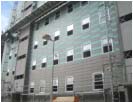
There are 21 urban complexes located in the city, with approximately 8,000 households. Renaissance Project will deal specifically with the urban complex located at El Picarral. For that reason, a district office of this Society was opened in order to inform the residents of the district and to make them participate in the process from the very beginning. The foreseen rehabilitation at the district of El Picarral in Zaragoza, Spain, will focus on demonstrating a rational use of energy in buildings constructed between 1950 and 1965 by means of: the biggest possible insulation in coverings and facades, search for up to a 40% in energy saving, replacement of downpipes and carpentry, put solar and photovoltaic panels, and centralisation of heating and hot water, through agreements with the proprietors. This pilot experience has had a great mimetic effect on other districts of Zaragoza in which the intention is also to act on, and that can affect up to 3,000 households more
In this urban complex, Renaissance Project will focus on several aspects:
- Make an analysis of buildings before and after its rehabilitation.
- Training on the environmental measures that can be adopted to improve the comfort and professional activity, not only of the technicians who take part in the rehabilitation process, but also of household users.
- Rehabilitation of blocks by means of increasing measures for passive energy saving, and introducing renewable energies in that rehabilitation (installation of solar and photovoltaic panels).
Rehabilitation: Cándido Domingo Public School
El Picarral district, in the city of Zaragoza, combines the efforts promoted by the City of Zaragoza related to sustainable rehabilitation. The goal is to incorporate renewable energies and suitable thermal insulation through the rehabilitation of a building for public uses, in order to serve as an example of its incorporation to public building.
By means of this school, thermal insulation efficiency and in the installation of a series of photovoltaic panels (up to 20 Mw) that will serve as example of renewable energies installation in public buildings, is tried to be obtained.
The budget for these actions is 284,000 Euros (included in the work packet identified in the Project as WP 3.3.1. "Rational Use of Energy"), and 273,000 Euros (included the work packet identified as WP 3.3.2. "Use of Renewable Energies").
The survey carried out by the Centro Nacional de Energías Renovables (National Centre for Renewable Energies) on the characteristics of the enclosures at Cándido Domingo School and on the insulation requirements in accordance with what was passed in Renaissance Project, proposes a series of "U" values for the different enclosures, as it is specified in the attached copy of the survey.
As far as photovoltaic installations is concerned, a survey on the shadows has been carried out but this centre, reaching the conclusion that only the installation of 20 Mws is feasible, as it has been indicated before.


